UP Scholarship Eligibility 2026-27: Income Limit, Qualification, Age Limit & Rules
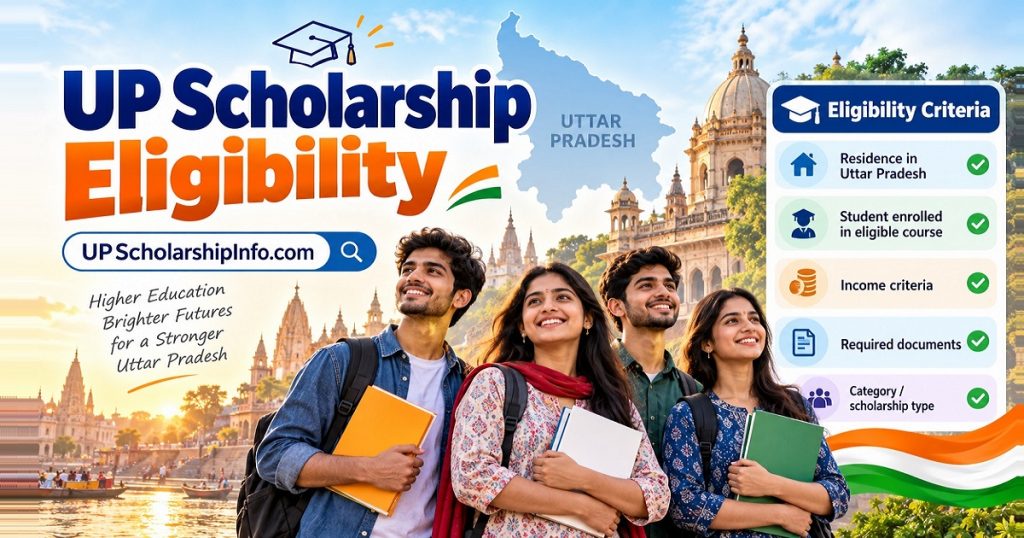
UP Scholarship Eligibility 2026-27 depends on your course, family income, category, Uttar Pradesh residency, and academic record. Students in Classes 9–12 and eligible undergraduate (UG), postgraduate (PG), diploma, ITI, and professional courses may apply under the relevant scheme.
Before applying, students should check their income certificate, educational qualification, recognized institution, previous examination results, and applicable scholarship guidelines.
Quick Answer: There is no single income limit, minimum percentage, or age rule that applies to every UP Scholarship scheme. Commonly published Post-Matric income limits are ₹2 lakh for General, OBC, and Minority students and ₹2.5 lakh for SC/ST students. However, published 2026–27 sources contain conflicting figures. Students must confirm their category’s limit through the official UP Scholarship portal before applying.
Who Is Eligible to Apply for UP Scholarship?
Students must meet the eligibility requirements of their selected scholarship category, including educational qualification, annual family income, residence, and institution recognition.
| Eligibility Criteria | Requirements |
|---|---|
| Academic Session | 2026–27 |
| State | Uttar Pradesh |
| Eligible Classes | Classes 9–12 |
| Higher Education | Eligible UG, PG, ITI, Diploma, and Professional Courses |
| Categories | General, OBC, SC, ST, Minority |
| Family Income | Scheme-specific annual income limit |
| Qualification | Required previous examination and course admission |
| Minimum Marks | According to the applicable scheme |
| Age Limit | Scheme-specific conditions |
| Domicile | UP residence requirements, where applicable |
| Institution | Recognized and eligible school, college, or university |
| Application Type | Fresh or Renewal |
| OTR | Required where applicable |
| Official Website | scholarship.up.gov.in |
Important: Meeting the basic eligibility criteria does not guarantee scholarship approval. Applications undergo institution and government department verification.
UP Scholarship Income Limit: Category-Wise Criteria
Annual family income is one of the most important UP Scholarship requirements. The applicable income ceiling depends on the student’s category, educational level, and scholarship scheme.
Category-Wise Annual Family Income Limit
| Category | Commonly Reported Annual Income Limit |
|---|---|
| General | ₹2,00,000 |
| OBC | ₹2,00,000 |
| SC | ₹2,50,000 |
| ST | ₹2,50,000 |
| Minority | ₹2,00,000 |
Note: Some recent publications report different category allocations. Students should verify the relevant government department’s official notice. Pre-Matric and special scholarship schemes may have separate income rules.
Income Limit for General Category Students
General category students may apply for eligible scholarship schemes when their annual family income falls within the prescribed limit.
The commonly reported Post-Matric income ceiling is ₹2 lakh per year, although students should confirm the applicable 2026–27 notification.
Other requirements include recognized institution admission, appropriate academic qualification, and valid income documentation.
Income Limit for OBC Students
OBC applicants must satisfy the income and category requirements established by the relevant scholarship department.
A ₹2 lakh annual family income ceiling is commonly reported for Post-Matric OBC scholarships, subject to official confirmation.
Students may also need a valid caste certificate, income certificate, and previous academic records.
Income Limit for SC/ST Students
SC and ST students may qualify for applicable Pre-Matric and Post-Matric scholarship schemes.
A ₹2.5 lakh annual family income limit is commonly published for certain Post-Matric schemes, but students must confirm the exact ceiling specified for the 2026–27 session.
Category verification, course eligibility, and academic requirements also apply.
Income Limit for Minority Students
Eligible Minority category students must follow the requirements of their specific scholarship scheme.
Commonly published Post-Matric guidance refers to an annual family income ceiling of ₹2 lakh. However, students should verify scheme availability, category coverage, and the currently applicable limit before registration.
Is There a Minimum Family Income Requirement?
Students searching for the UP Scholarship minimum income should understand the difference between a minimum income and an income ceiling.
An income ceiling means family income must not exceed the maximum amount permitted under the selected scheme.
It does not automatically mean that a family must earn a certain minimum amount to qualify.
How Is Annual Family Income Calculated?
Family income is generally assessed on an annual basis using the income certificate required by the scholarship scheme.
Applicants should verify the certificate holder’s name, yearly income, issue date, and issuing authority.
Incorrect income information may delay verification or result in rejection.
What Is the Validity of an Income Certificate?
The accepted validity of an income certificate depends on current scheme instructions.
Students should not assume that an older certificate remains valid for the 2026–27 academic session.
Check the certificate requirements before completing the scholarship application.
Educational Qualification: Class 9 to Postgraduate Eligibility
Educational qualification depends on the student’s current class or course.
Eligibility for Class 9 and 10 Students
Students enrolled in eligible Class 9 and 10 programs may apply under the Pre-Matric Scholarship category.
Basic requirements include:
- Enrollment in a recognized school.
- Required previous academic qualification.
- Applicable family income conditions.
- UP residency requirements.
- Valid application and supporting documents.
Students entering Class 9 must satisfy the admission requirements following Class 8, while Class 10 applicants must meet the applicable progression requirements.
Eligibility for Class 11 and 12 Students
Students studying in Classes 11 and 12 fall under the Post-Matric Intermediate Scholarship category.
Class 11 applicants generally need the required Class 10 qualification. Class 12 students must meet the relevant previous-year academic progression conditions.
Family income, school recognition, category details, and document verification also affect eligibility.
UP Scholarship Eligibility for UG Students
The UP Scholarship eligibility for UG students depends on admission to an eligible undergraduate course at a recognized institution.
Students studying BA, BSc, BCom, BBA, BCA, and other covered undergraduate programs may apply under the relevant Post-Matric Other Than Intermediate, or Dashmottar, scheme.
Important requirements include:
- Admission to a recognized university or college.
- Enrollment in a scholarship-eligible undergraduate course.
- Required Class 12 or equivalent qualification.
- Family income within the applicable limit.
- Valid category and academic documents.
- Compliance with Fresh or Renewal application rules.
Can first-year UG students apply?
Eligible first-year undergraduate students may apply through the Fresh application process when instructed by the portal.
Continuing students should check whether they qualify for Renewal.
UP Scholarship Eligibility for PG Students
The UP Scholarship eligibility for PG students generally covers eligible postgraduate courses such as MA, MSc, MCom, and other recognized master’s programs.
Postgraduate applicants must meet the selected scheme’s educational, income, residence, and category requirements.
Students should verify:
- Enrollment in an eligible postgraduate course.
- Recognition of the university or institution.
- Completion of the required undergraduate qualification.
- Current family income and supporting documents.
- Applicable Fresh or Renewal registration requirements.
Receiving a scholarship during graduation does not automatically guarantee postgraduate scholarship approval.
Students starting a new postgraduate program should confirm the appropriate registration type.
Eligibility for BTech, BEd, ITI and Diploma Students
Students pursuing professional and technical education may qualify under applicable Post-Matric scholarship categories.
Courses may include BTech, BEd, ITI, Polytechnic, and eligible diploma programs.
Eligibility depends on course recognition, institution registration, educational qualification, and the selected scholarship scheme.
Not every professional course is automatically covered.
Course-Wise Eligibility Table
| Class or Course | Scholarship Category |
|---|---|
| Class 9–10 | Pre-Matric |
| Class 11–12 | Post-Matric Intermediate |
| BA, BSc, BCom | Post-Matric Other Than Intermediate |
| BBA, BCA | Applicable Dashmottar Scheme |
| MA, MSc, MCom | Post-Matric Other Than Intermediate |
| BTech, BEd | Applicable Professional/Post-Matric Scheme |
| ITI, Polytechnic | Applicable Post-Matric Scheme |
| Diploma Courses | Subject to Scheme Approval |
UP Scholarship Minimum Percentage and Passing Criteria
Students frequently search for UP Scholarship percentage criteria, minimum percentage, and required marks after Class 12.
There is no reliably established single percentage that applies to every scholarship category and educational level.
Students must satisfy the qualifying examination and academic progression requirements specified by their scholarship scheme.
What Percentage Is Required for UP Scholarship?
The required percentage, where prescribed, depends on the scholarship category, course, and relevant department guidelines.
Students should check the current official instructions instead of relying on percentage requirements published for another scheme or academic year.
Is 60% Required for UP Scholarship?
A universal 60% minimum marks requirement has not been verified for all UP Scholarship schemes.
Students with marks below 60% should review their specific scheme’s academic requirements before assuming they are ineligible.
Their previous examination result, course admission, and progression status may be relevant.
UP Scholarship Percentage Criteria for General Category
General category students must satisfy the academic conditions of their selected scheme.
There is no confirmed universal percentage that should be applied to every General-category applicant.
Students should check both academic qualification and family income requirements before registration.
UP Scholarship Percentage Criteria for OBC and SC/ST Students
OBC and SC/ST students must meet the qualifying examination and academic progression conditions prescribed for their respective schemes.
Applicants should not assume that a percentage requirement published for another category applies to them.
Their course, institution, category documentation, and family income must also satisfy the current rules.
UP Scholarship Class 12 Percentage Criteria
Students applying for an undergraduate scholarship after Class 12 must meet the admission requirements of their chosen course.
Whether an additional scholarship-specific percentage is required depends on the applicable scheme.
Students should check their Class 12 marksheet, admission status, and current government guidelines.
Can Students With Backlogs Apply?
Students with backlogs, supplementary examinations, or pending papers may face additional academic progression checks.
Eligibility depends on the relevant Fresh or Renewal rules and the institution’s academic record.
Students should confirm their status with their college scholarship officer.
Can Failed Students Apply for UP Scholarship?
Failing a previous examination or repeating a class may affect scholarship eligibility, especially for Renewal applications.
The final decision depends on the specific scheme’s progression and repetition rules.
Students should review the relevant official instructions before applying.
Is CGPA Accepted Instead of Percentage?
Students whose university uses a CGPA system should follow the scholarship portal and institution’s instructions.
If percentage conversion is required, use the officially approved conversion formula issued by the university or examination authority.
UP Scholarship Age Limit: Minimum and Maximum Age
The UP Scholarship age limit depends on the educational and scheme-specific requirements applicable to an applicant.
A single universal minimum or maximum age limit covering every scholarship category has not been confirmed.
What Is the Maximum Age Limit?
Students should check whether their selected scholarship scheme specifies a maximum age requirement.
Age restrictions, where applicable, must be followed according to the current official guidelines.
Is There a Minimum Age Requirement?
Minimum-age conditions may be related to school admission, educational level, or specific scholarship provisions.
Applicants should check the relevant academic and scheme rules instead of assuming a fixed age applies to everyone.
Can Students Above 25 or 30 Years Apply?
Being above 25 or 30 years of age does not automatically establish ineligibility under every UP Scholarship scheme.
Students must verify their course eligibility, enrollment status, academic progression, and any scheme-specific age restrictions.
Category-Wise Eligibility Rules
Scholarship requirements vary according to the applicant’s category and the government department responsible for the selected scheme.
SC and ST Scholarship Eligibility
Eligible SC/ST students must meet the applicable family income conditions, recognized course requirements, and category verification rules.
Students should have the required caste certificate and relevant academic documents.
OBC Scholarship Eligibility
OBC students must satisfy their scheme’s income criteria, category documentation requirements, and educational qualification rules.
Applicable guidelines may be issued through the Backward Classes Welfare Department.
General Category Scholarship Eligibility
General category students may qualify for scholarship schemes that cover their educational level and circumstances.
They must meet income, academic, institution recognition, and other applicable conditions.
Minority Scholarship Eligibility
Minority applicants must confirm that their selected scheme is available for the 2026–27 academic session.
Eligibility depends on community coverage, course level, income, academic requirements, and current government instructions.
Domicile and Residence Requirements
UP Scholarship schemes generally support eligible students who meet Uttar Pradesh residency conditions.
The exact domicile or residence documentation depends on the chosen scholarship scheme.
Is UP Domicile Required?
Uttar Pradesh domicile or other accepted residence proof may be required.
Students should confirm the prescribed documentation through their scholarship category’s official guidelines.
Can UP Students Studying Outside the State Apply?
Students must verify the relevant course, institution recognition, registration, and domicile requirements.
Can Students From Other States Apply?
Admission to a college in Uttar Pradesh does not automatically qualify a student from another state for UP Scholarship.
Applicants must satisfy the specific scheme’s residency and category conditions.
Fresh and Renewal Application Eligibility
Fresh and Renewal scholarship applications have different requirements depending on the student’s previous scholarship record and current educational status.
Who Can Apply for a Fresh Scholarship?
Fresh applications generally cover new eligible applicants and certain students entering a new educational course or scholarship category.
Applicants must meet current income, academic, identity, and admission requirements.
Who Is Eligible for Scholarship Renewal?
Renewal applicants must satisfy the applicable continued-enrollment and academic progression requirements.
Previous scholarship registration details and updated academic information may be necessary.
Students can check the complete process in the UP Scholarship Renewal Guide.
Fresh vs Renewal Requirements
| Requirement | Fresh | Renewal |
|---|---|---|
| Application | New eligible application | Eligible continuation |
| Admission | Current admission details | Current enrollment |
| Income | Applicable income limit | Current scheme requirements |
| Academic Record | Qualifying examination | Previous-year progression |
| Previous Registration | As instructed | Generally required |
| Verification | Required | Required |
Can Students Renew After Changing College?
Students changing their institution should confirm whether Fresh registration, Renewal, or an update to existing scholarship details is required.
The new institution’s eligibility and verification requirements must also be satisfied.
Documents Required for UP Scholarship
Students should prepare the documents specified for their educational level, category, and application type.
| Document | Purpose |
|---|---|
| Aadhaar Card | Identity verification |
| Income Certificate | Annual family income |
| Caste Certificate | Applicable category verification |
| Domicile/Residence Proof | Residence eligibility |
| Previous Marksheet | Educational qualification |
| Admission Details | Current course verification |
| Fee Receipt | Applicable fee information |
| Bank Account Details | Payment requirements |
| Photograph | Application identification |
| Mobile Number | Registration and authentication |
| Previous Registration Details | Renewal application |
| OTR Details | Where required |
Important: Not every applicant needs exactly the same documents. Students must follow the official checklist for their selected scheme.
Is an Income Certificate Compulsory?
Income-based scholarship schemes normally require valid annual family income documentation.
Students should verify the accepted certificate format, issuing authority, and validity requirements.
Is OTR Required for 2026–27?
One Time Registration (OTR) is part of the current UP Scholarship registration workflow for applicants to whom the requirement applies.
Students should follow the portal’s latest identity verification and registration instructions.
For detailed instructions, read UP Scholarship OTR Registration 2026–27.
Who Is Not Eligible for UP Scholarship?
Common reasons include:
- Income Limit Exceeded: Annual family income is above the officially prescribed ceiling.
- Ineligible Institution: The school or college does not meet the selected scheme’s recognition requirements.
- Ineligible Course: The chosen educational program is not covered.
- Academic Requirements Not Met: The applicant does not meet qualifying examination or progression conditions.
- Incorrect Documents: Income, category, identity, or academic details do not match.
- Residence Requirements Not Met: The applicant fails the relevant domicile or residency conditions.
- Other Scholarship Restrictions: The applicant does not satisfy rules concerning overlapping scholarship benefits.
How to Check UP Scholarship Eligibility Online
Students can manually verify their eligibility by checking the relevant government scheme instructions.
Step 1: Visit the Official Portal
Open scholarship.up.gov.in and find the applicable 2026–27 scholarship guidelines.
Step 2: Select Your Scholarship Category
Choose the relevant Pre-Matric, Post-Matric Intermediate, Post-Matric Other Than Intermediate, or Other State category.
Step 3: Verify Your Family Income
Compare the annual income shown on your certificate with the official ceiling for your category and scheme.
Step 4: Check Academic Requirements
Confirm your previous qualification, course eligibility, academic progression, and recognized institution.
Step 5: Review Documents and Registration
Check your Aadhaar, OTR, category certificate, income certificate, and required registration information.
Step 6: Complete the Applicable Application
Follow the Fresh or Renewal process after confirming the eligibility requirements.
This is a manual checking method, not a claim that the government provides an automated eligibility checker.
Eligibility vs Scholarship Approval
Being eligible for UP Scholarship does not guarantee final approval or payment.
Eligibility means the student satisfies the basic requirements of the selected scheme.
Approval depends on the submitted application, supporting documents, institution verification, and relevant government department checks.
Why Can an Eligible Student’s Application Be Rejected?
Common reasons include incorrect academic information, invalid certificates, document mismatches, incomplete forms, or unsuccessful verification.
After submitting an application, students can follow their verification progress through the UP Scholarship Status Guide.
Frequently Asked Questions
What Are the Eligibility Requirements for UP Scholarship 2026–27?
Students must satisfy the applicable family income limit, educational qualification, residence conditions, category requirements, and recognized institution rules.
What Is the Income Limit for UP Scholarship?
Commonly reported Post-Matric figures include ₹2 lakh and ₹2.5 lakh annual income ceilings. Because published sources disagree about category allocations for 2026–27, students should confirm the exact official limit for their scheme.
What Is the Minimum Percentage for UP Scholarship?
There is no confirmed universal minimum percentage for every scholarship category. Students should check their specific academic and progression requirements.
Is 60% Compulsory for UP Scholarship?
A universal 60% requirement has not been verified. Students with lower marks may qualify if they meet their selected scheme’s academic conditions.
Can UG Students Apply for UP Scholarship?
Yes. Eligible undergraduate students enrolled in recognized and covered courses may apply under the relevant Post-Matric scholarship scheme.
Can PG Students Apply for UP Scholarship?
Yes. Eligible postgraduate students may apply under the relevant Dashmottar scholarship category, subject to income, academic, and institutional requirements.
What Is the Maximum Age Limit for UP Scholarship?
Applicants should review the age conditions, if any, in their selected scholarship guidelines.
Can Students With Backlogs Apply?
Eligibility depends on academic progression, examination status, and the applicable Fresh or Renewal scheme rules.
Can General Category Students Apply?
Yes. Eligible General category students can apply for scholarship schemes that cover their category and educational level, subject to prescribed requirements.
Can Private College Students Apply?
Students studying at eligible recognized and registered private institutions may qualify if their specific course is covered by the scholarship scheme.
Is UP Domicile Required?
The accepted domicile or residence documents depend on the selected scheme.
Is an Income Certificate Compulsory?
Income-based scholarship schemes generally require valid family income documentation in the prescribed format.
Conclusion
UP Scholarship Eligibility 2026-27 depends on several important factors, including family income, student category, educational qualification, academic progression, Uttar Pradesh residency, and institution recognition.
Students in Classes 9–12 and eligible UG, PG, diploma, ITI, and professional courses should check their relevant scholarship guidelines before applying.
Applicants must also verify their category-specific income limit, marks requirements, age conditions where applicable, required certificates, and Fresh or Renewal registration process.
Meeting the basic eligibility requirements does not guarantee scholarship payment. Applications must pass the necessary institution and department verification stages.
For the latest application information, registration guidance, and scholarship updates, visit the UP Scholarship 2026–27 Guide or consult the official government portal at scholarship.up.gov.in.